
"Faced with the risk of Russia using natural gas as a weapon against the EU and cutting off supplies completely before winter, the European Commission has put forward a proposal to reduce consumption in all Member States by 15% between August 2022 and March 2023, compared to the same period in the last five years. While technically convincing, the proposal has a major flaw: it will sow divisions between Member States."
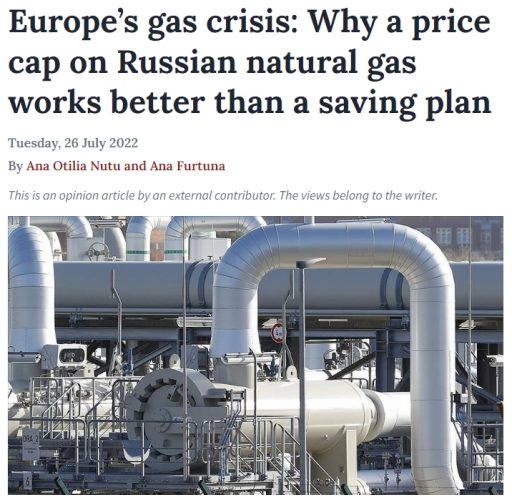
Otilia Nuțu and Ana Furtună published in Brussels Times a very articulate position on the issue of Russian gas consumption in the European Union. In short, the two authors argue very well for the imposition of price caps at EU level to limit the Kremlin's room for maneuver. The article describes with concrete figures how such a mechanism would work and why Putin could not circumvent it by storing gas internally or redirecting it to other markets.
I think that such a capping mechanism could be coupled with mechanisms to help Ukraine's economy, with the cap also functioning as an economic sanction for Russia.
Congratulations for the article. I think MEPs should support such an approach.
And congratulations, Ramona Strugariu, who has already sent a letter to the European Commission on this issue!
Ana Otilia Nuțu is co-chair of the Steering Committee of the Eastern Partnership Civil Society Forum (CSF) and energy policy analyst at Think Tank Expert Forum.
Ana Furtună is Director of the Secretariat of the Eastern Partnership Civil Society Forum.
An abstract of the article:
"Faced with the risk of Russia using natural gas as a weapon against the EU and cutting off supplies completely before winter, the European Commission has put forward a proposal to reduce consumption in all Member States by 15% between August 2022 and March 2023, compared to the same period in the last five years. While technically convincing, the proposal has a major flaw: it will sow divisions between Member States."
While technically convincing, the proposal has a major flaw: it will sow division among Member States at a time when European unity in confronting Russian blackmail is of paramount importance. The EU can and will phase out its dependence on Russian fossil fuels over several years, but not in 2022.
The focus this year must be on devising measures that unite the whole EU, politicians and the public alike, and deal with Russia on gas imports with one voice. The maximum cuts Russia is offering can easily be overcome by a united EU, which has both the infrastructure and the storage to deal with the problems across the EU and in individual countries.
Gas production is quite rigid. After starting the summer of 2021 with an all-time low of 15 bcm in storage (compared to 40 bcm in a typical year), it had an additional 25 bcm of spare capacity that it could manipulate to deplete EU storage.
Thus, Russia could create shortages on the EU market only by delivering small quantities through pipelines to the EU.
Any measure that would drastically reduce gas prices in the EU would be extremely popular. It could be legally introduced as a sanction against Russia, overriding the price clauses in existing contracts (which Gazprom had no restrictions on unilaterally breaking anyway).
The Kremlin can still play with selective discounts, but coupling the price cap with a simple solidarity mechanism will discourage Gazprom from trying."


 Română